The Ceiling Critic: Living With a Smoke Alarm That Has Never Once Apologised
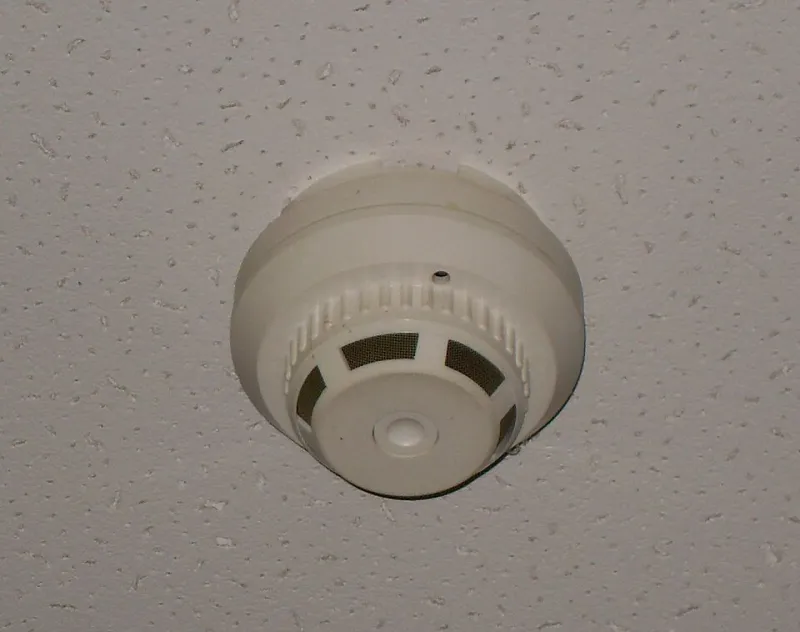
Photo: Georg Pik, Public domain, via Wikimedia Commons
Every household has that one resident who believes the world revolves around them. At Household No. 6, ours is screwed to the ceiling at the top of the stairs, powered by a nine-volt battery and an unshakable sense of its own importance. The smoke alarm does not simply detect smoke. It judges, interrupts, escalates and then denies all knowledge of having done so. If it had a LinkedIn profile, it would describe itself as a 'passionate safety influencer' and list 'raising concerns' as a core competency.
We have learned to live with it. We have not learned to like it.
A Resident With No Off Switch
The smoke alarm arrived, as these things do, with the house. We assumed it was a neutral piece of kit, like a doorstop or a radiator. We were wrong. Within a week it had established itself as the most theatrical member of the family, capable of turning a slightly tan slice of bread into a full-scale emergency without pausing for breath. It has the timing of a Shakespearean actor and the judgement of a parking warden.
Its speciality is the false alarm. Not the gentle, apologetic kind either. This is a full-volume, ceiling-mounted aria of accusation, designed to make the entire street assume we have set fire to the toaster. The neighbours have stopped ringing the doorbell. They simply glance at our kitchen window, nod at one another, and carry on with their evenings.
The Toast Tribunal
Toast is the smoke alarm's sworn enemy. Not burnt toast, you understand. Burnt toast would be too obvious. Our alarm prefers to intervene at the precise moment a slice of bread achieves a pleasant golden-brown. It waits until the kettle has boiled, the butter is out, and the tea is stewing, then unleashes a siren loud enough to rearrange the cutlery drawer.
We have tried everything. We have lowered the toaster setting. We have stood beside it like anxious parents at a school nativity. We have opened windows, waved tea towels, and once, in a moment of desperation, attempted to reason with it. None of it matters. The alarm has a zero-tolerance policy on browning, and it enforces that policy with the zeal of a referee who has been waiting all season to give a red card.
Crumpets are worse. A crumpet under the grill is essentially a smoke alarm trigger with butter on top. We now grill crumpets with the extractor fan on, the back door open, and one family member stationed by the hallway with a broom, ready to begin the silencing ritual.
The Oven Blind Spot
Here is the mystery that keeps us up at night, usually while fanning the ceiling with a copy of the Radio Times. When the oven genuinely smokes, the alarm says nothing. Nothing. A Sunday roast can produce enough airborne grease to give the kitchen a faint blue haze, and the smoke alarm remains as silent as a teenager asked to empty the dishwasher.
We have watched it happen. A rogue sausage roll spills its filling onto the oven floor. The kitchen fills with a smell that suggests a bonfire has been held indoors. The extractor fan makes a brave but doomed attempt to help. And the smoke alarm? Not a peep. It sits there, smug and unblinking, apparently waiting for us to relax before it chirps at three in the morning for reasons known only to itself.
There is no consistency. It will scream at a piece of bread, then ignore an actual smouldering oven glove. It is not a safety system. It is a mood ring for the house, and the mood is usually 'I have something to say and you will hear it.'
The 3am Battery Chirp
The low-battery chirp is the smoke alarm's most passive-aggressive achievement. It never happens during daylight. It never happens when someone is standing on a stepladder with a fresh battery in hand. It happens at three in the morning, on a Tuesday, when the house is asleep and the only person awake is the cat, who is already unimpressed.
The chirp is not loud, exactly. It is small and sharp and regular, like a tiny metronome counting down to madness. You lie there, staring at the ceiling, trying to work out whether it is the smoke alarm, the fridge, or your own imagination. By the fourth chirp you are wide awake, by the sixth you are considering a new career, and by the tenth you are standing in the hallway in your dressing gown, glaring at a plastic disc that has no intention of explaining itself.
The next morning, nobody remembers who was supposed to change the battery. This is because nobody was supposed to change the battery. The smoke alarm has no owner. It has an audience.
The Broom-Handle Protocol
Every household develops its own rituals. Ours involves a broom handle, a stepladder we have never actually found, and a specific angle of attack that has been passed down through the family like a folk remedy. The broom handle is kept in the utility room, behind the ironing board, and is deployed whenever the alarm becomes too enthusiastic to ignore.
There is a technique to it. You do not jab. You do not flail. You extend the broom handle upwards with the calm dignity of a person disarming a burglar alarm in a sitcom, locate the central button, and press it firmly. The alarm will stop. For eight seconds. Then it will start again, as if to say, 'I hear your broom handle, and I raise you one more shriek.'
Eventually, after several rounds, it gives in. The silence is brief but glorious. We lower the broom handle, return it to its place, and pretend we have won. The smoke alarm, meanwhile, is already planning its next performance.
The Peace Treaty
We have, in our way, reached an understanding. We do not claim to have defeated the smoke alarm. Nobody defeats the smoke alarm. But we have negotiated a fragile peace, based on a few unwritten terms.
It is allowed to shriek at toast. We will not take it personally. It is allowed to ignore the oven, although we reserve the right to mutter about it. It is allowed the occasional 3am chirp, provided it accepts that we will not be changing the battery until a reasonable hour. And it is allowed to remain on the ceiling, watching us, judging our grilling choices, never once accepting blame for the chaos it causes.
In return, we keep it supplied with batteries and pretend it is a valued member of the household. It is not. It is a tiny plastic tyrant with a built-in siren. But it is our tiny plastic tyrant, and at Household No. 6, that is the closest thing to harmony we are likely to get.